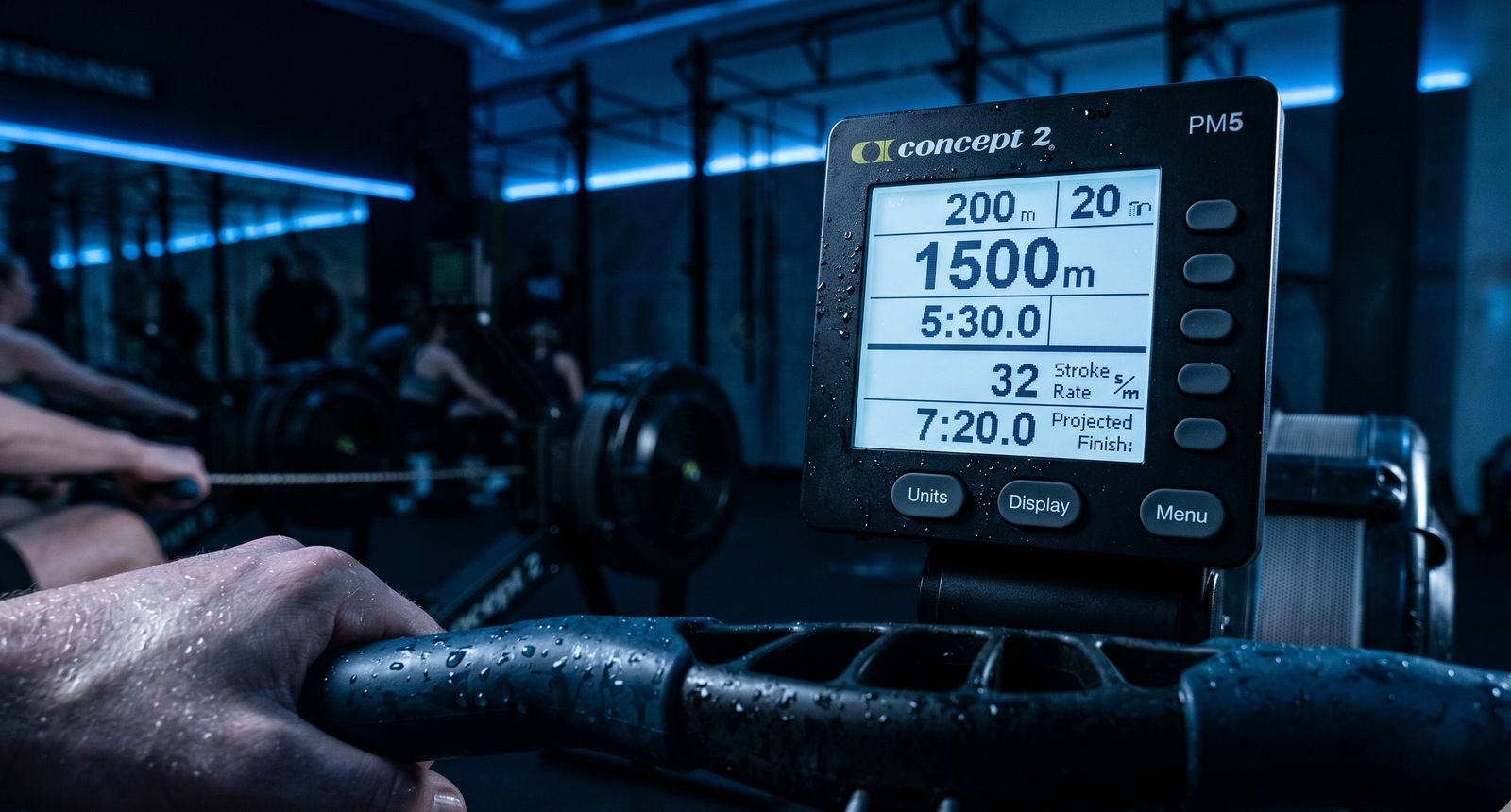
The 2K erg test is the ultimate indoor rowing benchmark. But most people leave seconds on the table because of bad pacing. Here's how to get it right.
The pacing debate: even vs negative split
There are two schools of thought on 2K pacing:
- Even splitting means holding the same pace from start to finish. Simple, predictable, and safe.
- Negative splitting means rowing the second half faster than the first. Harder to execute but physiologically more efficient.
Both work. But for most rowers, a slightly conservative start with a strong finish produces better times than going out hard and hanging on.
The reason is simple: starting too fast builds lactate early. Once you're deep in oxygen debt at 500m, the remaining 1500m becomes survival rather than racing. A controlled start keeps lactate manageable and leaves you with something for the push.
A practical pacing plan
Here's a pacing template based on your goal split. If you're targeting 2:00/500m average:
- 0-500m: 2:01-2:02. Controlled, strong strokes. Resist the urge to sprint.
- 500-1000m: 2:00. Settle into your target rhythm. This should feel hard but sustainable.
- 1000-1500m: 2:00-1:59. The hardest part. Mentally commit to holding pace. Don't look at meters remaining.
- 1500-2000m: 1:57-1:55. Sprint. Everything you have left. Raise the rate and drop the split.
Want your splits analyzed automatically? ErgManiac's AI analysis breaks down your pacing after every workout and tells you exactly where you gained or lost time.
Stroke rate plan
Your stroke rate matters as much as your split. Here's a typical plan:
- First 5 strokes: 34-36 spm. High rate to build momentum off the start.
- Settle (strokes 6-20): Drop to your race rate. Don't rush this transition.
- Body of the race (20-1600m): 28-32 spm depending on your style. Find a rhythm and lock in.
- Sprint (last 300-400m): 32-36 spm. Raise the rate. Shorten the recovery slightly. Don't sacrifice drive length.
The most common mistake is starting at a high rate and not being able to sustain it. Better to settle quickly and save the high rate for when it matters.
The "fly and die" problem
This is the most common 2K mistake: going out 3-5 seconds faster than goal pace in the first 500m, then watching your split climb for the remaining 1500m.
Why it happens:
- Adrenaline at the start makes goal pace feel easy
- You see a fast number and don't want to "waste" it
- Ego from watching the split
Why it kills your time:
- You build lactate faster than your body can clear it
- By 800m you're in oxygen debt that lasts the rest of the piece
- The average split ends up slower than if you'd started controlled
The fix: set a hard pace cap for the first 500m. If your goal is 2:00, do not go faster than 1:58 in the first quarter. Trust the plan.
Race day warmup
Your warmup directly affects your 2K performance. Don't skip it.
- 10 minutes easy rowing at UT2 pace (2K + 20-25 seconds)
- 3 x 10 strokes at race pace with 1 minute easy between
- 2 minutes easy to catch your breath
- Start the test within 3-5 minutes of finishing warmup
The goal is to prime your cardiovascular system without burning glycogen. You should feel warm and slightly elevated, not tired.
Mental strategy for the middle 1000m
The hardest part of a 2K is meters 600-1400. You're past the adrenaline of the start but nowhere near the finish. Here's how to survive:
- Break it into chunks. Don't think about the full distance. Focus on the next 250m or the next minute.
- Count strokes. Counting to 10 or 20 repeatedly occupies your mind and prevents panic.
- Focus on technique. When it hurts, focus on one thing: drive connection, handle speed, body swing. Technical focus reduces perceived effort.
- Don't check the monitor constantly. Glance every 30-60 seconds. Staring at the numbers makes the time pass slower.
After the test
When you finish, don't just walk away. Use the data:
- Were your splits even? Did you fly and die?
- Was your stroke rate consistent or did it drop in the middle?
- Compare to your last test. Where did you improve?
ErgManiac captures your full 2K data via photo scan and gives you AI analysis covering pacing, efficiency, and specific recommendations for your next test. See how it compares to tracking manually.
For a full training approach to dropping your 2K time, read our complete 2K improvement guide.