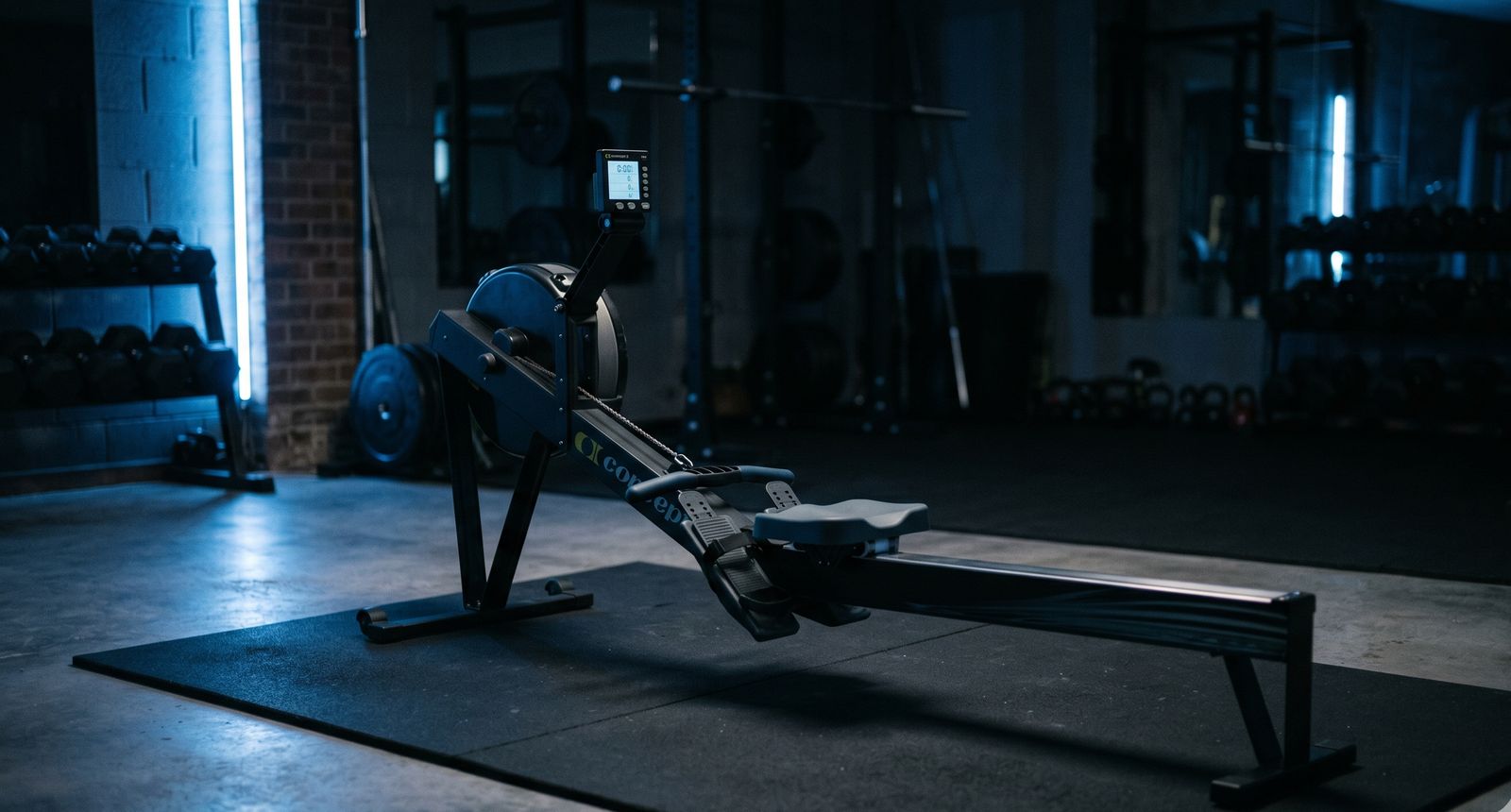
Starting on a Concept2 rowing machine can feel overwhelming. The screen shows splits, stroke rates, watts, and distance - but how do you actually structure your training to improve? This guide gives you a clear, progressive plan to go from your first erg session to consistent, effective training.
Why You Need a Plan
Most beginners make the same mistake: they sit down, row as hard as they can for 20 minutes, and repeat. This leads to burnout, poor technique, and plateaus. A structured plan builds your aerobic base gradually, teaches proper pacing, and sets you up for long-term improvement.
The foundation of all rowing fitness is steady-state aerobic work - longer, lower-intensity sessions that build your engine without destroying your body. Elite rowers spend 80% of their training time at low intensity. As a beginner, you should too.
Understanding the Concept2 Performance Monitor
Before diving into the plan, here's what matters on your screen:
- Split (per 500m): Your pace. Lower is faster. This is the number you'll track most.
- Stroke rate (s/m): Strokes per minute. Beginners should aim for 18-22 for steady state.
- Distance: Total meters rowed in the session.
- Time: Elapsed workout time.
Don't worry about watts, calories, or drag factor for now. Focus on split and stroke rate.
The 8-Week Beginner Plan
This plan assumes 3-4 sessions per week. Each session builds on the last.
Weeks 1-2: Foundation
The goal is learning the movement and building basic endurance.
- 3 sessions per week
- Session: 20 minutes of steady rowing at a comfortable pace
- Target stroke rate: 18-20 s/m
- Target effort: You should be able to hold a conversation (RPE 3-4 out of 10)
- Focus: Smooth, connected strokes. No rushing the recovery.
Weeks 3-4: Building Volume
Now you start extending session length.
- 3-4 sessions per week
- Session A (x2): 25 minutes steady state
- Session B (x1-2): 30 minutes at the same easy pace
- Target stroke rate: 18-22 s/m
- Focus: Consistent splits. If your pace varies by more than 5 seconds throughout the piece, you're going too hard at the start.
Want a plan built for you? ErgManiac's AI plan generator creates personalized programs based on your fitness level and goals - with a free 30-day trial.
Weeks 5-6: Introducing Structure
Time to add variety while keeping the base.
- 4 sessions per week
- Session A (x2): 30 minutes steady state
- Session B (x1): 4 x 5 minutes with 2 minutes rest. Slightly faster than steady state (RPE 5-6).
- Session C (x1): 35 minutes easy steady state
- Focus: Negative splitting - try to row the second half of each session slightly faster than the first.
Weeks 7-8: First Test
You're ready to see how far you've come.
- 4 sessions per week
- Session A (x2): 30-35 minutes steady state
- Session B (x1): 6 x 3 minutes with 2 minutes rest. Push the pace slightly (RPE 6-7).
- Session C (x1): 2K test. Row 2,000 meters as fast as you can. This is your baseline.
Pacing Your 2K Test
For your first 2K test, here's a simple strategy:
- Start controlled - Don't sprint the first 500m. Start at what feels like 70% effort.
- Build through the middle - Settle into a rhythm at 500m. Aim for even splits.
- Push the last 500m - This is where you dig in.
Your 2K time becomes the baseline for all future training zones. Many coaches use it to calculate steady-state and interval paces.
Common Beginner Mistakes
- Going too hard on easy days: If you can't talk, you're going too hard. Slow down.
- High stroke rate: Pulling at 28-30 s/m on steady state wastes energy. Aim for 18-22.
- Gripping the handle too tight: Light fingers. The power comes from your legs, not your hands.
- Rushing the recovery: The slide back should take twice as long as the drive.
What Comes Next
After 8 weeks, you'll have a solid aerobic base and a 2K benchmark. From here you can:
- Start a periodized plan targeting a specific goal (5K, 2K PB, half marathon)
- Add training zones (UT2, UT1, AT, TR, AN) to your programming
- Work toward a faster 2K time
- Incorporate complementary strength work
ErgManiac generates personalized training plans based on your 2K time, fitness level, and available training days. The AI coach can also answer questions about technique, pacing, and programming - so you're never guessing what to do next. See how it compares to other apps.