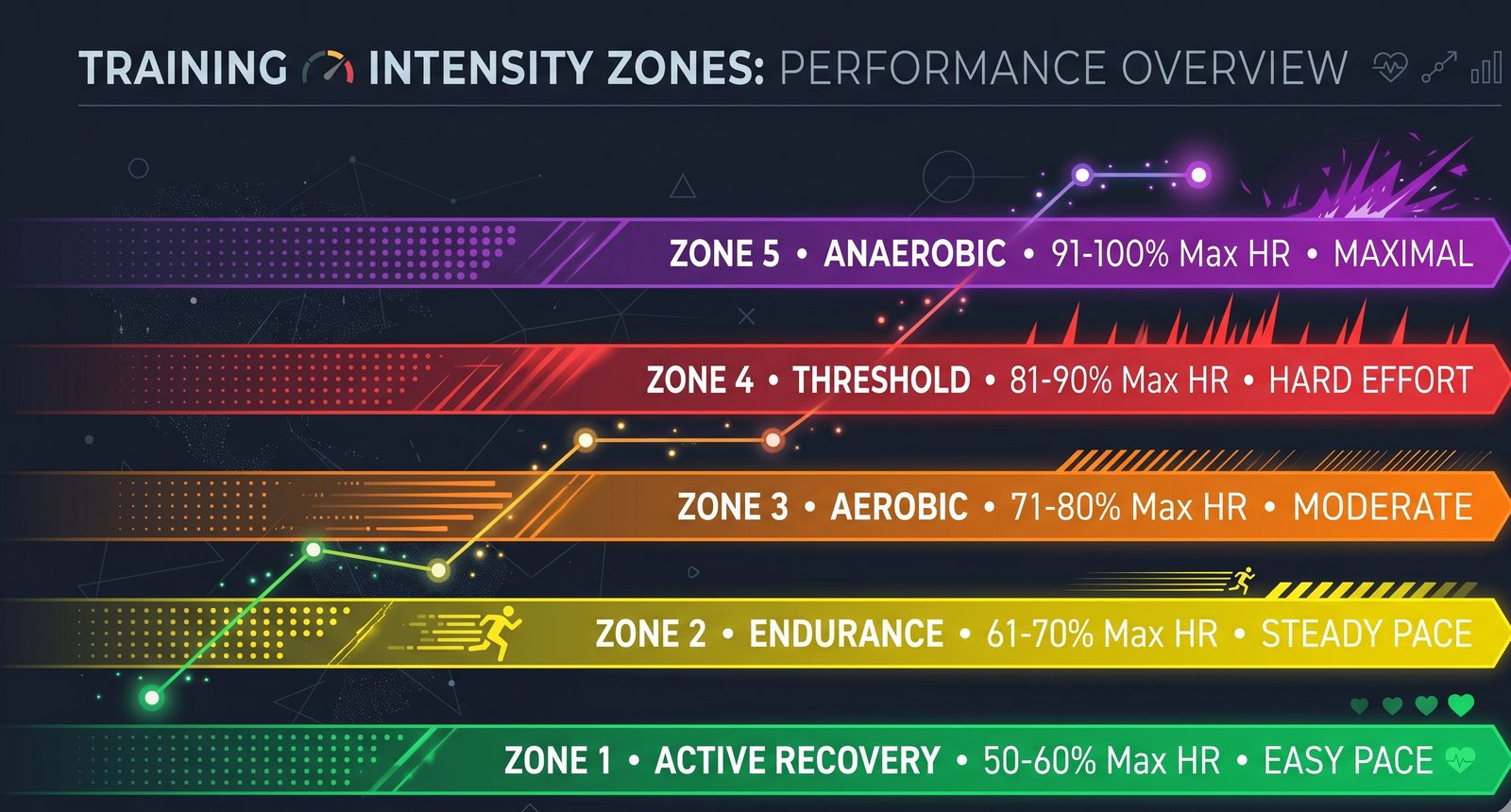
If you've spent any time in rowing communities, you've seen people talk about "UT2" and "AT" sessions. These training zones are the foundation of structured rowing training - used by FISA (World Rowing), national team programs, and club coaches worldwide. Here's what they mean and how to use them.
Why Train in Zones?
Different intensities produce different physiological adaptations. Going hard every session might feel productive, but it actually limits your development. A zoned approach ensures you're training the right energy systems in the right proportions.
The principle is simple: go easy on easy days so you can go hard on hard days. Most of your training should be low intensity to build the aerobic engine. Hard sessions are limited but precise.
The 5 Rowing Training Zones
UT2 - Utilization Training 2 (Easy Steady State)
- Effort: Conversational. You can easily talk in full sentences.
- Heart rate: ~55-70% of max HR
- Pace: 2K split + 20-30 seconds
- Stroke rate: 18-20 s/m
- Session examples: 40-60 minutes steady, 3 x 20 min with 2 min rest
- Purpose: Builds aerobic base, improves fat oxidation, increases mitochondrial density. This is the bread and butter of rowing training.
UT2 is the zone most rowers skip because it feels "too easy." But it's where Olympic rowers spend the majority of their training time. If you're not doing at least 3 UT2 sessions per week, you're leaving fitness on the table.
UT1 - Utilization Training 1 (Moderate Steady State)
- Effort: Aware of working but sustainable. Short phrases possible.
- Heart rate: ~70-80% of max HR
- Pace: 2K split + 12-18 seconds
- Stroke rate: 20-24 s/m
- Session examples: 30-45 min steady, 4 x 10 min with 3 min rest
- Purpose: Develops aerobic capacity and lactate clearance. Bridges the gap between base work and threshold training.
UT1 is harder than it looks - the temptation is to drift up into AT territory. If you're grimacing or can't speak at all, you've gone too far.
AT - Anaerobic Threshold
- Effort: Comfortably hard. You can say a few words but not hold conversation.
- Heart rate: ~80-85% of max HR
- Pace: 2K split + 5-10 seconds
- Stroke rate: 24-28 s/m
- Session examples: 5 x 5 min with 3 min rest, 3 x 10 min with 4 min rest
- Purpose: Raises lactate threshold - the point at which lactate accumulates faster than your body can clear it. A higher threshold means you can sustain a faster pace before "blowing up."
AT work is where many rowers see the most direct 2K improvement. But it only works if it's built on a solid UT2/UT1 base.
Want your zones calculated automatically? ErgManiac uses your personal bests to set targets for all 5 zones and checks adherence after every workout.
TR - Transport / VO2max
- Effort: Hard. 90-95% effort. You cannot speak.
- Heart rate: ~85-95% of max HR
- Pace: 2K split or slightly faster
- Stroke rate: 28-32 s/m
- Session examples: 8 x 500m with 3 min rest, 5 x 3 min with 4 min rest
- Purpose: Increases maximum oxygen uptake (VO2max). Trains your body to deliver and use more oxygen. This is the "speed work" of rowing.
TR sessions are demanding and require full recovery (48+ hours before the next hard session). One per week is enough for most athletes.
AN - Anaerobic
- Effort: Maximal. All-out sprint.
- Heart rate: Max
- Pace: Faster than 2K split
- Stroke rate: 32-38 s/m
- Session examples: 8 x 200m with full recovery, 6 x 30 seconds max with 4 min rest
- Purpose: Develops peak power and anaerobic capacity. Important for starts, sprints, and the final push in races.
AN training is used sparingly - typically only in competition phases. It's high injury risk and requires long recovery.
How to Calculate Your Zones
All zones are calculated from your 2K personal best:
- UT2: 2K split + 20-30s
- UT1: 2K split + 12-18s
- AT: 2K split + 5-10s
- TR: 2K split +/- 2s
- AN: 2K split - 5s or faster
Example: If your 2K split is 2:00/500m:
- UT2: 2:20-2:30
- UT1: 2:12-2:18
- AT: 2:05-2:10
- TR: 1:58-2:02
- AN: 1:55 or faster
Structuring a Training Week
For a recreational rower training 5 days per week:
- Monday - UT2: 45 min steady state
- Tuesday - AT: 5 x 5 min / 3 min rest
- Wednesday - UT2: 50 min steady state
- Thursday - Rest
- Friday - UT2: 40 min steady state
- Saturday - TR: 8 x 500m / 3 min rest
- Sunday - Rest
Notice the ratio: 3 easy days, 1 threshold day, 1 VO2max day. This is the polarized model - high volume at low intensity, precise doses of hard work.
Common Zone Mistakes
- No man's land training: Rowing at UT1 when you should be at UT2. Going "medium" every day doesn't build base or sharpen speed. Pick a zone and commit.
- Too much intensity: More than 2 hard sessions per week (AT/TR/AN) leads to overtraining for most people.
- Ignoring heart rate: Pace alone can be misleading. If your heart rate is 10 beats above your UT2 target, slow down - regardless of what the split says.
- Skipping UT2: It's boring but it's the foundation. Without it, higher zones don't produce lasting gains.
Automating Zone Tracking
Manually tracking whether each workout fell in the right zone is tedious. ErgManiac calculates your training zones from your personal bests and shows zone adherence in post-workout analysis. The AI coach flags when you're spending too much time in the wrong zone and adjusts your training plan accordingly.
Ready to apply these zones? Check out our 2K improvement guide or the beginner 8-week plan. See how ErgManiac compares to other apps for zone-based training.