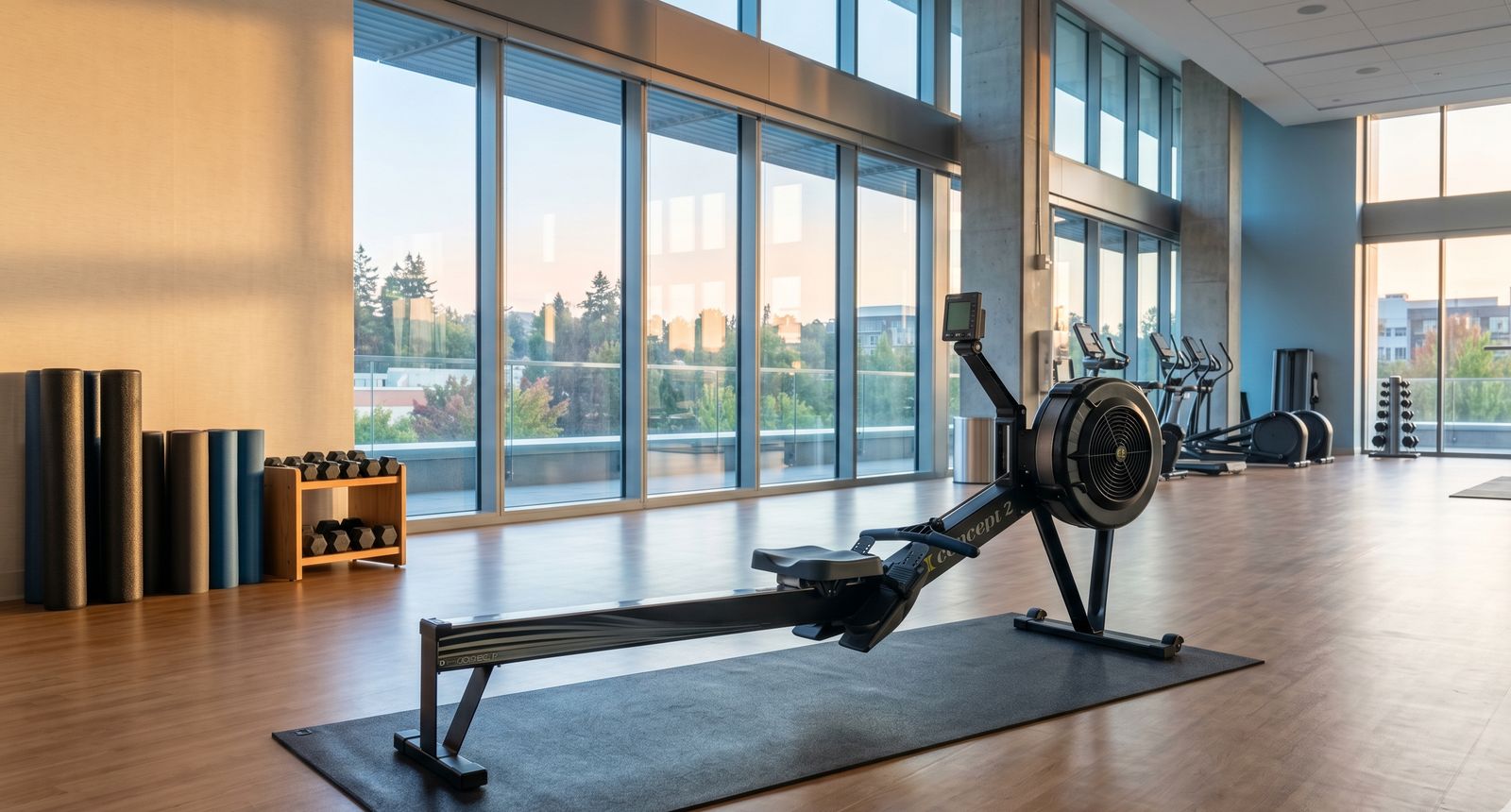
You've got access to a Concept2 erg. Maybe it's at the gym, maybe you bought one. Either way, the first month sets the foundation for everything that follows. Here's a structured approach to your first 30 days.
Before you start
Get familiar with the basics:
- Learn the stroke sequence: Legs push first, then body swings back, then arms pull. Reverse on the recovery: arms away, body forward, legs bend. Most of the power (60%+) comes from legs.
- Set the damper: Start at 3-5. Higher is not harder in a useful way - it just makes each stroke heavier. You can adjust later.
- Understand the monitor: Focus on pace (split per 500m) and stroke rate (spm). Here's a full guide to reading the monitor.
Week 1: Learn the movement (3 sessions)
The goal this week is smooth, connected strokes. Speed doesn't matter yet.
Session 1: 3 x 5 minutes with 2 minutes rest. Focus entirely on the stroke sequence. Legs-body-arms on the drive. Arms-body-legs on the recovery. Rate 18-20.
Session 2: 2 x 8 minutes with 2 minutes rest. Same focus. Try to make every stroke feel the same. Notice if you're gripping the handle too tight - relax your fingers.
Session 3: 1 x 15 minutes continuous. Keep the rate at 18-20. Don't worry about the split number. Just row smoothly.
Week 2: Build consistency (3-4 sessions)
You know the movement now. This week, start paying attention to your split.
Sessions: 20 minutes continuous at a pace where you can still hold a conversation. Rate 18-22.
Focus points:
- Keep your split consistent. If it varies by more than 5 seconds, you're pushing too hard at moments.
- Breathe rhythmically. Exhale on the drive, inhale on the recovery.
- If your lower back hurts, you're likely pulling with your back instead of pushing with your legs. Reset the sequence.
Building a logging habit early pays off. ErgManiac's free tier lets you track up to 20 workouts per month with basic analytics.
Week 3: Introduce variety (4 sessions)
Time to add some structure beyond "row for 20 minutes."
Session A (x2): 25 minutes steady state. Same conversational pace as week 2.
Session B: 4 x 4 minutes with 2 minutes rest. Row each interval 3-5 seconds faster than your steady state pace. Rate 22-24. This should feel noticeably harder but not all-out.
Session C: 30 minutes easy. This is your longest piece yet. The goal is just duration. Keep it comfortable.
Focus points:
- Notice how your body responds to the slightly faster intervals. You should recover during the rest and feel ready for the next one.
- On the 30 minute piece, practice negative splitting - try to row the second half slightly faster than the first.
Week 4: Test yourself (4 sessions)
You've built a base. Time to see where you stand.
Session A: 25 minutes steady state.
Session B: 5 x 3 minutes with 2 minutes rest. Push these a bit harder than last week's intervals. Rate 24-26.
Session C: 25 minutes steady state.
Session D: 2K test. Row 2,000 meters as fast as you can. Read our 2K pacing strategy guide before you test. Warm up with 10 minutes easy rowing and a few short bursts at pace.
What your 2K time means
Your first 2K time is a baseline, not a judgment. Here are rough benchmarks for context:
- Under 7:00: Strong recreational fitness
- 7:00-8:00: Solid foundation
- 8:00-9:00: Normal for a beginner
- Over 9:00: You're just getting started, and that's fine
Whatever your time, it becomes the basis for training zones and future improvement. Learn about the 5 training zones and how your 2K time determines your targets.
Common first-month mistakes
- Going too hard every session: If every workout leaves you destroyed, you're not building base fitness. Most sessions should feel moderate.
- High stroke rate on everything: Rating 28-30 on steady state wastes energy. Slow down the recovery. Aim for 18-22.
- Skipping sessions: Consistency beats intensity. Three 20-minute sessions are better than one 60-minute session.
- Ignoring technique for speed: Speed comes from good technique, not from pulling harder. Focus on connection and sequence.
What comes next
After 30 days you have:
- A consistent stroke
- A 2K baseline time
- A training habit
From here, you can follow a structured training plan. Our beginner 8-week plan picks up right where this guide leaves off.
ErgManiac generates personalized plans based on your 2K time, available days, and goals. The AI coach answers any technique or training questions along the way. Start with the free tier or try Pro free for 30 days.